On this page
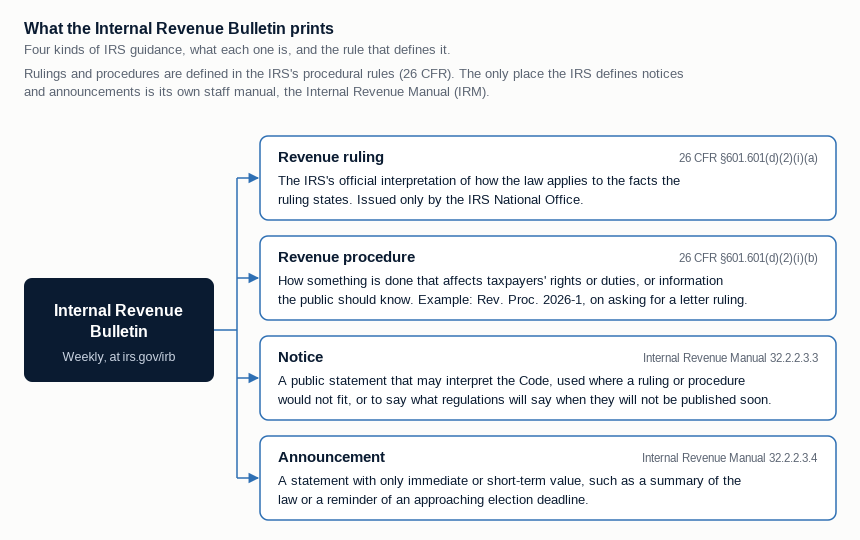
Treasury regulations say how the Code works, and our guide to reading regulations on the eCFR covers them. Most of the IRS's other official guidance is published in one place: the Internal Revenue Bulletin. Revenue rulings, revenue procedures, notices and announcements are all printed there, alongside every new Treasury Decision.
The IRS puts out guidance in many places: its website, news releases, FAQ pages and the Bulletin. Only what is printed in the Bulletin is official guidance that the IRS has to follow and that you can rely on, the way you would rely on a court ruling. The IRS says: "Only guidance that is published in the Bulletin has precedential value." Everything else is helpful information, not a promise.
There is one exception. Some IRS FAQs are posted on a "fact sheet" page tied to an IRS news release. Those do not become official guidance. But if you followed one on a return and the IRS later disagrees, it can protect your client from a penalty.
01What is in each issue
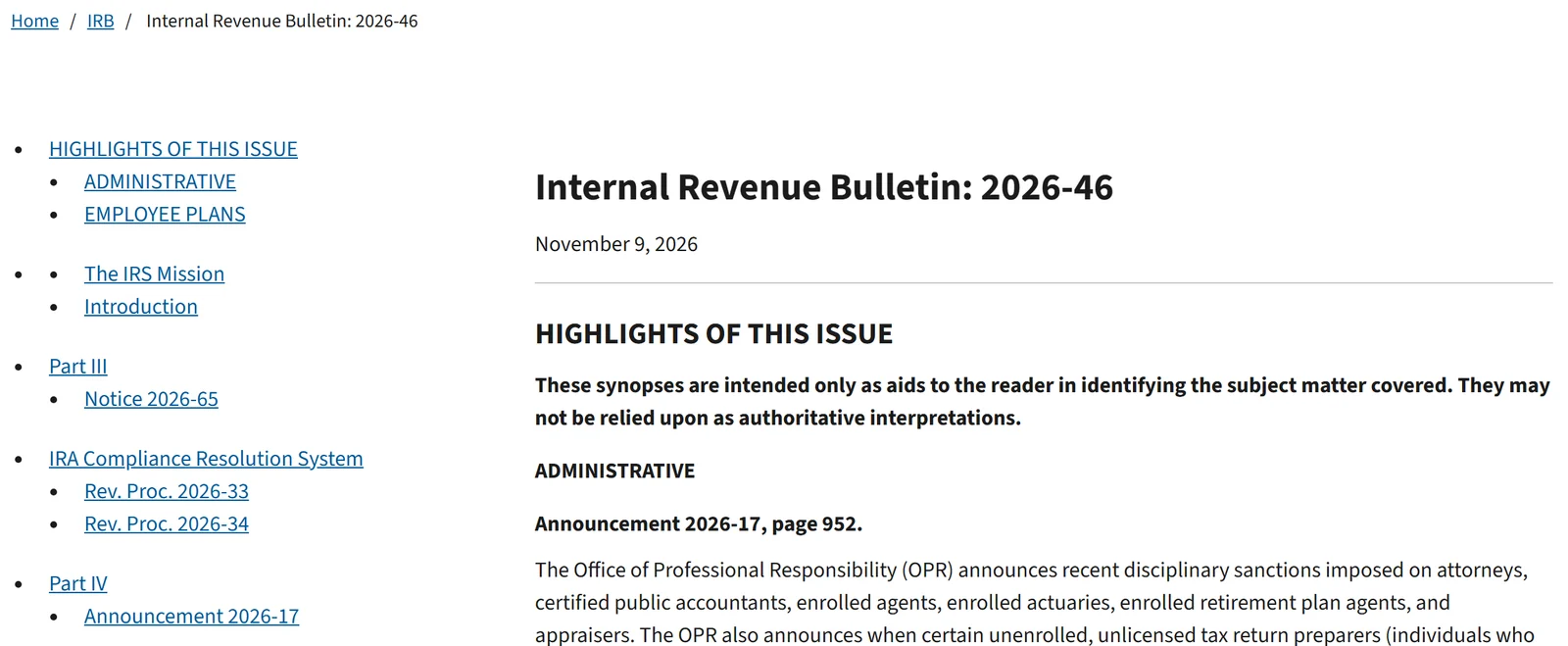
Each weekly issue opens with highlights, short summaries of what is inside. The IRS says they "may not be relied upon as authoritative interpretations", so always read the item itself. The contents are then sorted into four parts. The IRS's own manual explains what goes in each one.
- Part I, 1986 CodeThis part holds revenue rulings, Treasury decisions (the documents that publish new regulations) and Supreme Court opinions that apply the federal tax law, the Internal Revenue Code of 1986.
- Part II, Treaties and Tax LegislationThis part holds revenue rulings on tax treaties with other countries and their related Treasury decisions, and new tax laws from Congress with their committee reports. It is rarely used.
- Part III, Administrative, Procedural, and MiscellaneousThis part holds revenue procedures, notices and other material on how things are done. The Treasury's Bank Secrecy Act rulings also appear here.
- Part IV, Items of General InterestThis part holds proposed regulations, which are draft rules open for public comment, lists of tax professionals who have been disbarred or suspended, and announcements.
IRB 2026-46 on irs.gov. The contents list on the left shows only Part III and Part IV, because nothing was published under Part I or Part II that week.
Each issue ends with a page called Definition of Terms and two finding lists, which come up again below.
02Revenue rulings, revenue procedures, notices and announcements
03How much weight each one carries
The IRS ranks its own guidance. Its internal manual says: "Regulations would be the highest series, followed by revenue rulings and revenue procedures, then notices and announcements, and lastly, news releases." It adds that "a revenue ruling may never be used to modify a regulation."
Four rules decide how you use what the Bulletin publishes. The first three are about revenue rulings. The fourth is common for everything in the Bulletin.
- Rulings reach back"All published rulings apply retroactively unless otherwise indicated." A ruling issued in 2026 can govern a return for an earlier year unless the ruling itself says it applies only going forward.
- The facts must matchYou can rely on a revenue ruling for your client's own transaction without asking for a ruling of your own, but the IRS cautions against reaching the same conclusion "unless the facts and circumstances are substantially the same." Note in your working file where your facts match and where they differ.
- Only published guidance is precedent"Unpublished rulings will not be relied on, used, or cited as precedents by Service personnel in the disposition of other cases."
- Everything in the Bulletin counts as authorityWhen you decide whether a return position has substantial authority, the regulation that lists what counts includes revenue rulings, revenue procedures, and "notices, announcements and other administrative pronouncements published by the Service in the Internal Revenue Bulletin." Conclusions in treatises, articles and opinions by tax professionals are not authority. The same regulation says "a revenue ruling is accorded greater weight than a private letter ruling addressing the same issue."
04Words that tell you older guidance has changed
When the IRS publishes a new revenue ruling, revenue procedure, notice or announcement, it often says how the new item affects an older one, using words such as modified, revoked or superseded. Each word has a fixed meaning, printed on the Definition of Terms page at the back of every issue, and the IRS manual says these are the only words its staff may use for this. Check them before you rely on any older item.
| Word | What it means for the earlier item |
|---|---|
| Amplified | The position does not change, but now covers a variation of the original facts. |
| Clarified | Confusing wording is made clear. The position does not change. |
| Distinguished | A new ruling points out an essential difference between itself and the earlier one. |
| Modified | The substance of the earlier position is changed. |
| Obsoleted | The earlier ruling no longer decides future transactions, for example because its substance is now in regulations. |
| Revoked | The earlier position was not correct, and the new ruling states the correct one. |
| Superseded | The new ruling restates the substance of the earlier one, which it replaces. Rev. Proc. 2026-1 superseded Rev. Proc. 2025-1, for example. |
| Supplemented | A list in the earlier ruling, such as a list of countries, is added to. |
| Suspended | The earlier ruling will not be applied for now, pending new regulations, a court case or an IRS study. |
Obsoleted is not rare. Notice 2026-58, in IRB 2026-42 (October 13, 2026), obsoleted 71 revenue rulings, revenue procedures, notices and announcements at once. Two notices in 2025 had already obsoleted 9 and 83 more, and the IRS said it expects to revoke or obsolete more "in the near future." A ruling you have relied on for years may no longer apply to a new transaction.
05Finding an item and checking it is still good
- Search the Bulletinirs.gov/irb has a search box, with an "Include Historical Content" option for older issues. The IRS stopped publishing a cumulative index with IRB 2015-01, "due to the availability of electronic search tools", so search is the main way in.
- Use the finding listsEvery issue ends with a Numerical Finding List of what it contains and a Finding List of Current Actions on Previously Published Items, which lists what that issue changed. To find which issue holds an item, the IRS suggests the Numerical Finding List in the last issues of June and December.
- Watch for early releasesThe IRS often posts revenue rulings, revenue procedures and other guidance on irs.gov before they are printed in a Bulletin, in a folder it calls irs-drop, and announces them through its GuideWire email alerts. An early-release item has no Bulletin page number yet.
06One item, start to finish: Rev. Proc. 2026-35
On November 5, 2026, the IRS announced the inflation-adjusted amounts for 2027 for "almost 70 tax provisions", including the tax rate schedules and the standard deduction. Follow that one item through the system.
- The news releaseIR-2026-133, the IRS's 133rd news release of 2026, summarizes the changes. It is a pointer to the guidance, and news releases come last in the IRS's own ranking.
- The early releaseThe full text, Rev. Proc. 2026-35, is posted as a PDF in the irs-drop folder. Section 1 says it "sets forth inflation-adjusted items for 2027", and section 4.01 says it "applies to taxable years beginning in 2027." One sign of an early release: the posted copy still reads "[Release Date, 2026]" where the date will go.
- The BulletinWhen it is printed in a weekly issue, it gets its permanent citation, in the form Rev. Proc. 2026-35, 2026-[issue] I.R.B. [page]. On the day this was written it had not yet appeared in an issue.
- Later changesFrom then on, check the finding lists for any item that modifies or supersedes it, the way Rev. Proc. 2026-1 superseded Rev. Proc. 2025-1.
07How to cite it
That is how we built the assistant's citations. Partnertax AI holds the Internal Revenue Bulletin alongside the Code and the regulations, and every item it cites links to the official page, so a reviewer can open the source and check it in one click. For the full checking routine, see how to verify an AI tax answer against primary sources.
This article is general information, not tax advice. It quotes the Internal Revenue Bulletin, 26 CFR §§601.601 and 1.6662-4, the Internal Revenue Manual and 26 U.S.C. §6110 as published on irs.gov, ecfr.gov and govinfo.gov, read on November 16, 2026. Verify every conclusion against the current official text before relying on it.