On this page
- Why read the eCFR instead of the official edition
- Where the Treasury regulations live
- How current is the text you are reading
- Which version governs the client's year
- Final, temporary and proposed, and how much weight each carries
- The preamble is in the Federal Register
- One regulation, top to bottom: §1.754-1
- What goes wrong, and how to cite
The eCFR is the current text of the Code of Federal Regulations, updated every business day by the Office of the Federal Register, and the IRS's own guidance page sends practitioners there. For your working file, a note to a client or a research memo, it is the right place to read a Treasury regulation.
ecfr.gov is careful about one thing. It says it is a daily compilation, not the official legal edition, and that anyone using it for legal research should check the result against the official edition and the Federal Register. The official edition is the yearly printing of the CFR on govinfo.gov. Federal law, at 44 U.S.C. §1510(e), treats that printed text, together with any later changes published in the Federal Register, as the correct text of a regulation unless someone proves otherwise.
Four government sources carry Title 26 regulations. This is the overview of each source and how it is used.
| Source | What it holds | How current | Use it for |
|---|---|---|---|
| eCFR (ecfr.gov) | The full text of every regulation as it stands today, kept by the Office of the Federal Register with the Government Publishing Office. | Updated every business day. Generally current within two business days of a change. | Everyday reading and research. Note the current-as-of date. |
| Annual CFR (govinfo.gov) | The official legal edition, printed one volume at a time by the Government Publishing Office. | Title 26 is reprinted once a year as of April 1, so it can be up to a year behind. | The text to cite when a position is being challenged. |
| Federal Register (federalregister.gov) | Each Treasury Decision as published by the Office of the Federal Register, with the preamble. Publication here is what gives a rule legal effect. | Daily. Shows the change, not the whole rule. | The preamble, and the change to cite alongside the annual text. |
| Internal Revenue Bulletin (irs.gov/irb) | Each Treasury Decision republished by the IRS with the preamble, beside the notices and revenue procedures that relate to it. | Weekly, usually a week or two after the Federal Register. Shows the change, not the whole rule. | Reading a Treasury Decision next to the IRS guidance that goes with it. |
01Why read the eCFR instead of the official edition
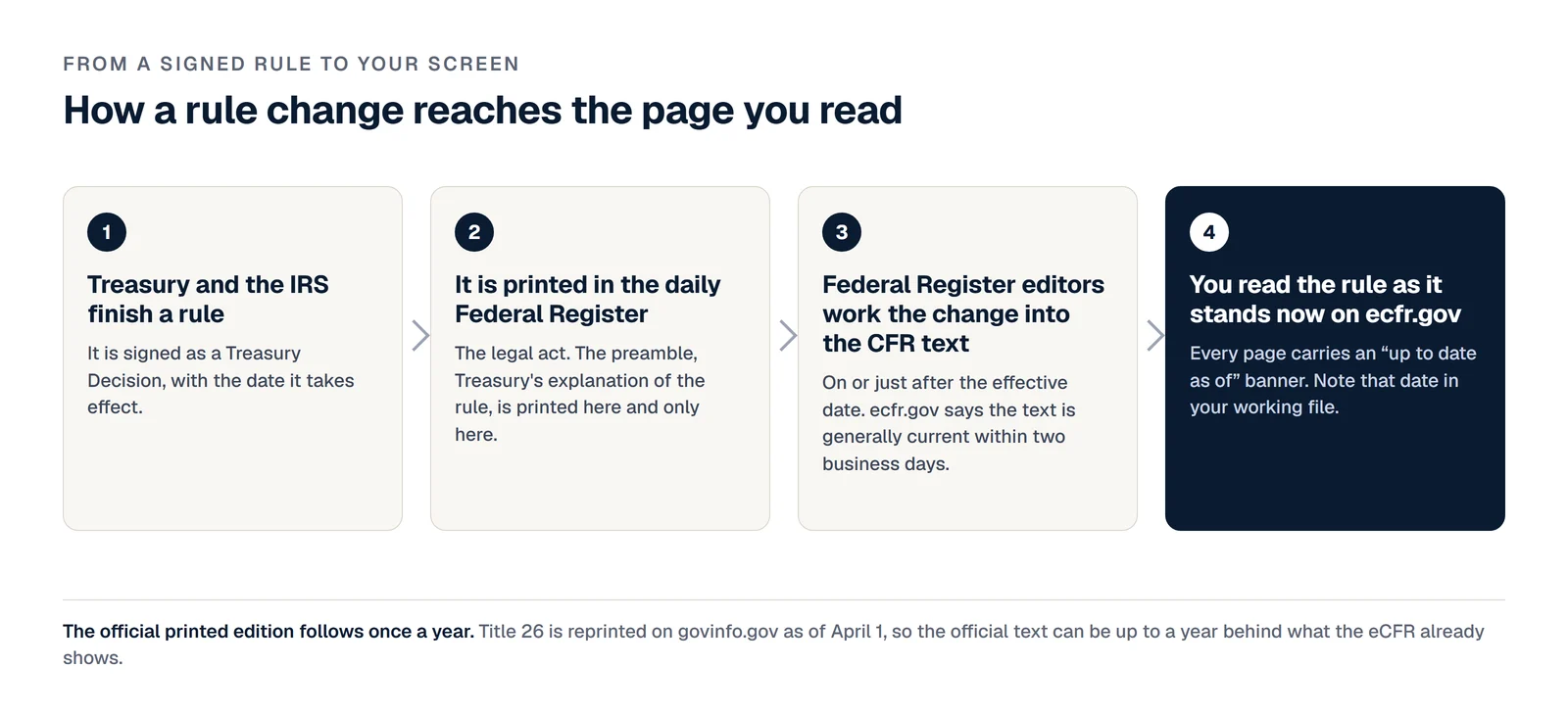
Why not read the annual edition, then? Because it is printed only once a year. Title 26 is revised as of April 1. A Treasury Decision finalized in May appears in the official edition the following April, so the official text can be up to a year behind and silent on the newest final regulations. Between editions, the official way to reach current law is to start with the yearly text, check the government's list of sections changed since then (the List of CFR Sections Affected), and apply every Federal Register change by hand. The eCFR is the Office of the Federal Register doing that work for you, every business day.
So the choice is between current text with an "unofficial" label and official text that may be a year out of date. For research, current text wins. That is why practitioners read regulations on the eCFR. The yearly edition keeps its role: when a position is being challenged, cite the official text and the Federal Register page alongside the eCFR version.
02Where the Treasury regulations live
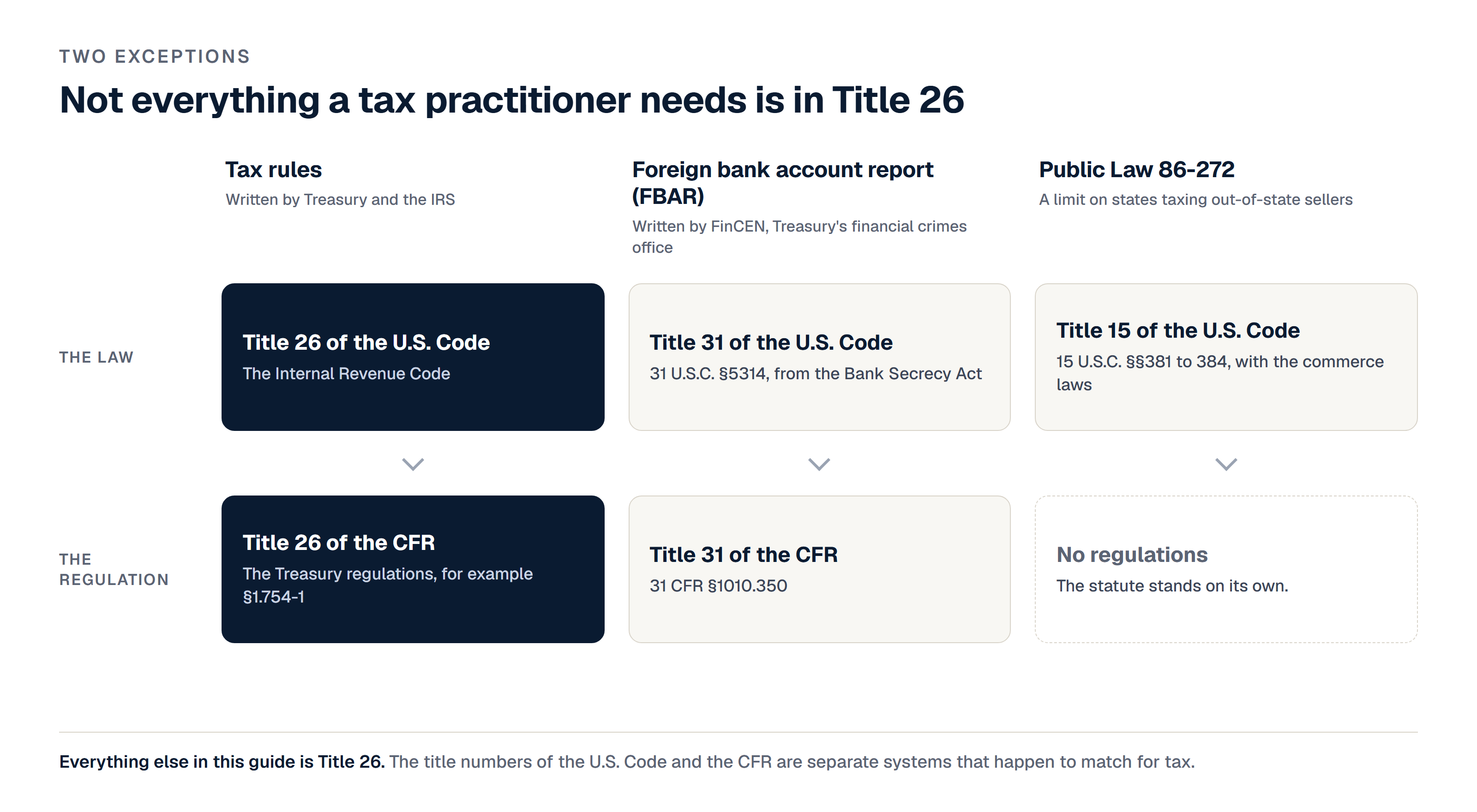
The Internal Revenue Code says what the rule is. The Treasury regulations say how it works. Both are Title 26: Title 26 of the United States Code is the Code, and Title 26 of the CFR is the regulations. Title 26 is split into subchapters by type of tax, in the same order the eCFR's table of contents shows them. The right-hand column gives one regulation from each so you can see the numbering.
| Subchapter | Subject | Parts | Example |
|---|---|---|---|
| A | Income tax | 1 to 18 | §1.199A-1, rules for the qualified business income deduction |
| B | Estate and gift taxes | 20 to 29 | §20.2031-1, what the gross estate includes and how it is valued |
| C | Employment taxes and collection of income tax at source | 30 to 39 | §31.3121(a)-1, what counts as wages |
| D | Miscellaneous excise taxes | 40 to 169 | §54.4980H-1, the employer shared responsibility payment |
| F | Procedure and administration | 300 to 499 | §301.6501(c)-1, exceptions to the time limit for assessing tax |
| G | Regulations under tax conventions | 500 to 599 | §509.101, the treaty with Switzerland |
| H | Internal revenue practice | 600 to 899 | §601.105, how the IRS examines returns and claims |
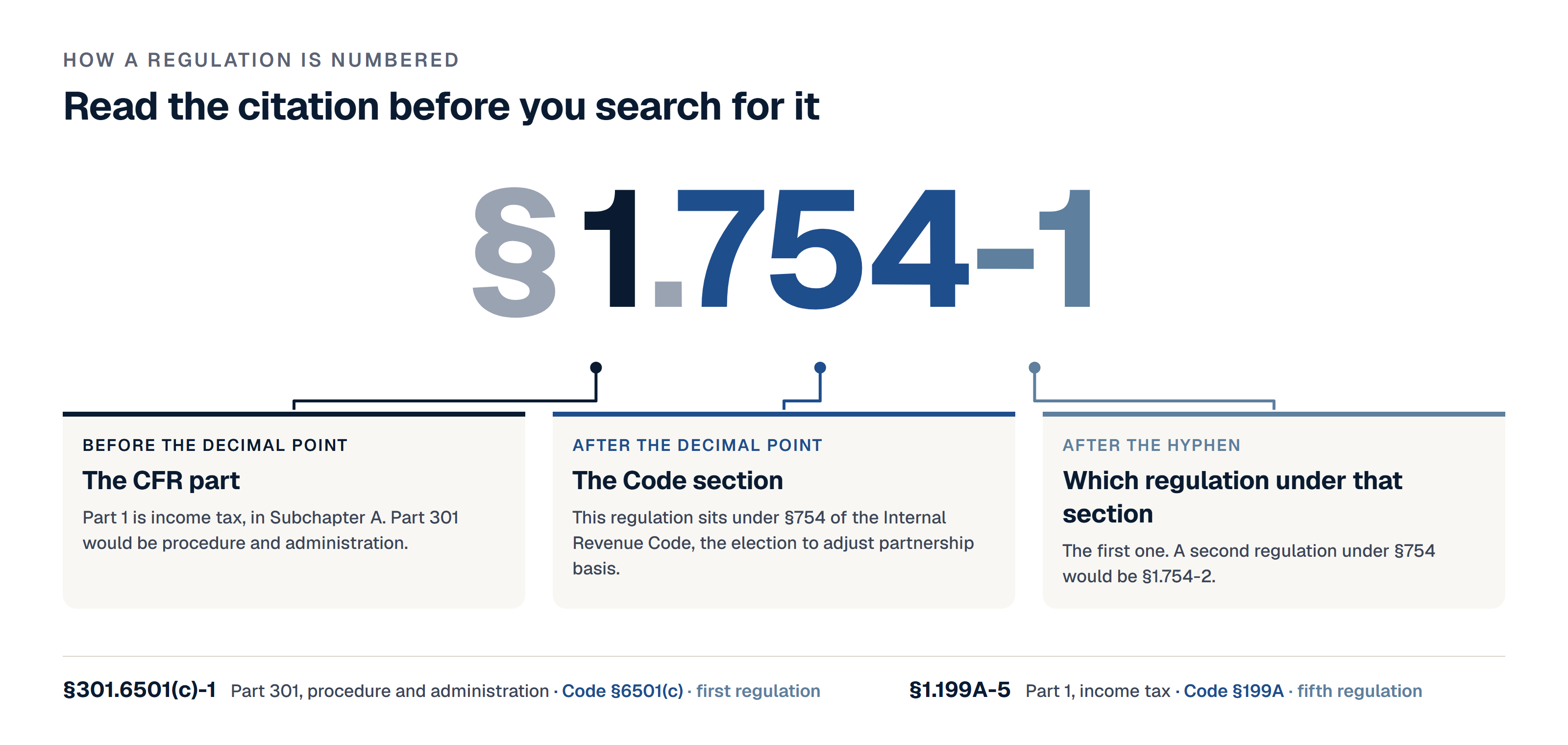
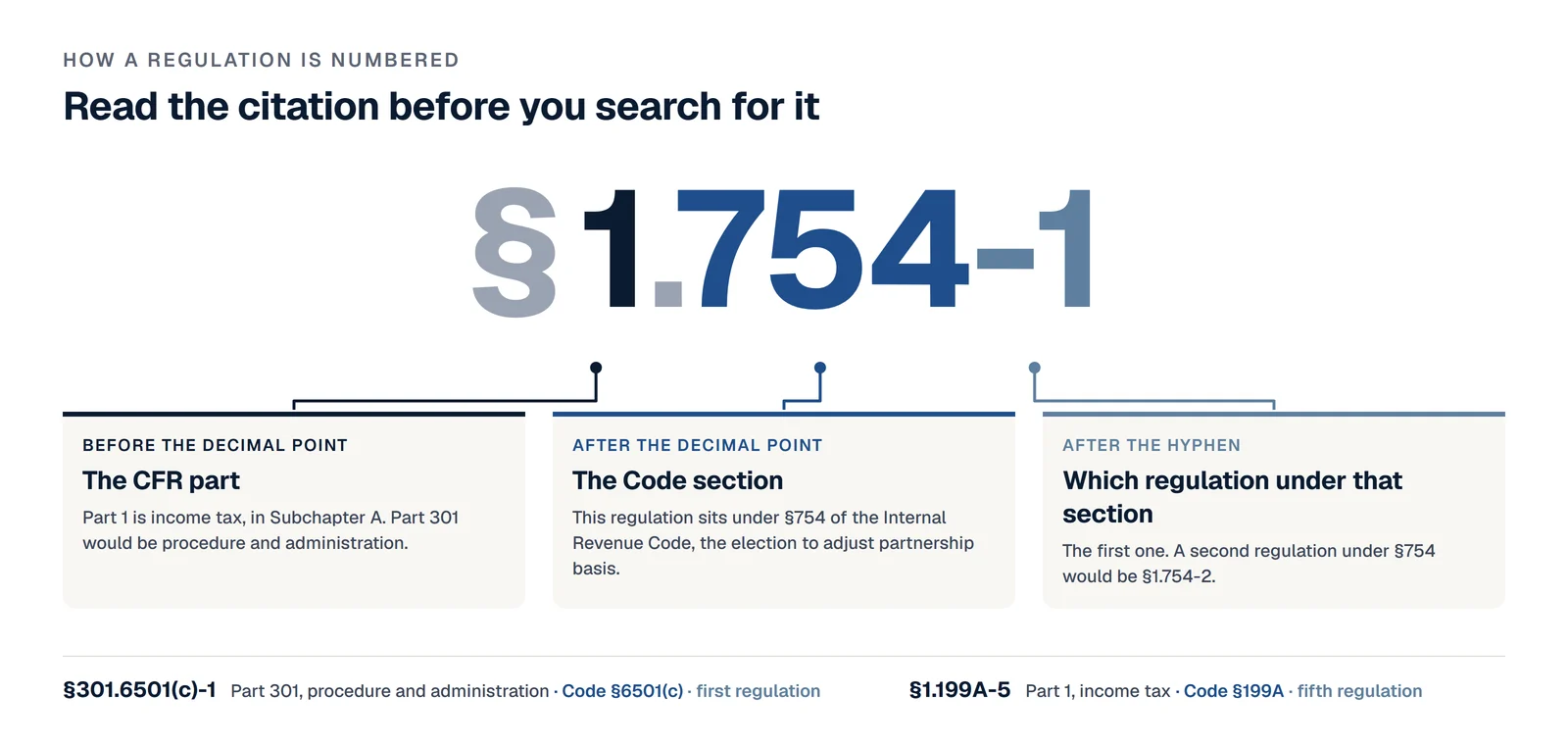
Regulation numbers follow the Code. The number before the decimal point is the CFR part, the number after it is the Code section, and the number after the hyphen counts the regulations under that section. §1.754-1 is the first income tax regulation under Code §754. That is why you can usually guess the citation before you search for it.
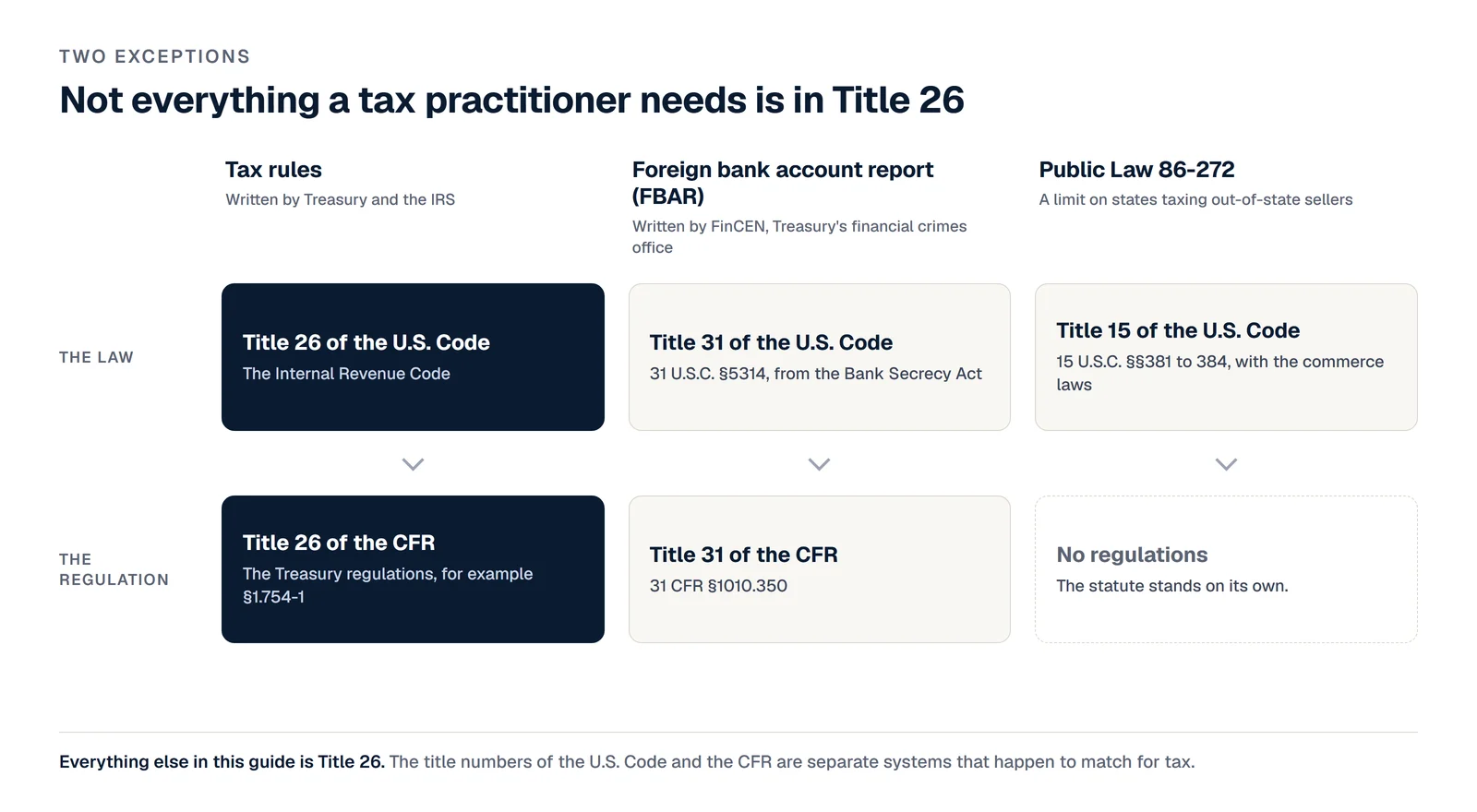
Two things a practitioner reaches for are not in Title 26 at all: the foreign bank account report, which comes from the Bank Secrecy Act, and Public Law 86-272, the federal limit on a state taxing an out-of-state seller. Everything else in this guide is Title 26.
03How current is the text you are reading
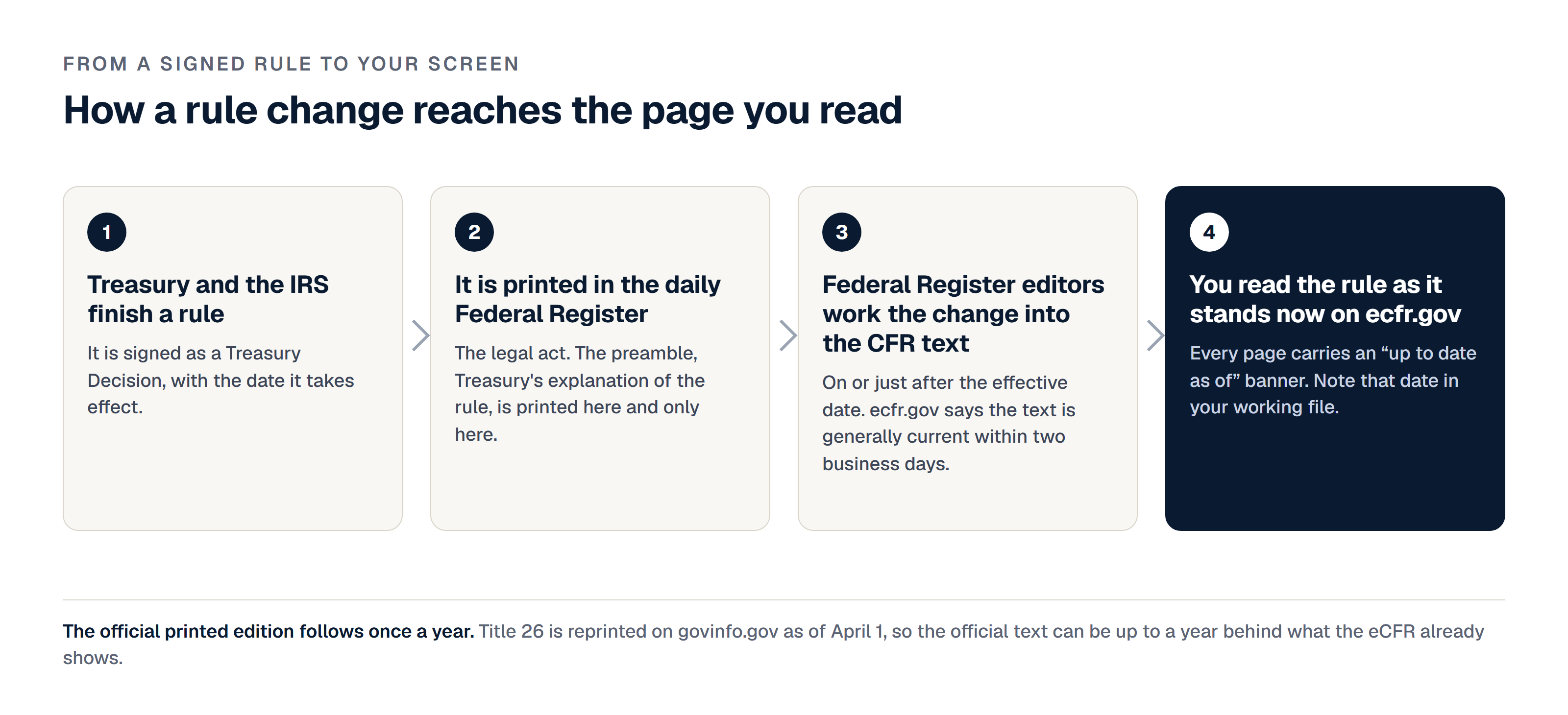
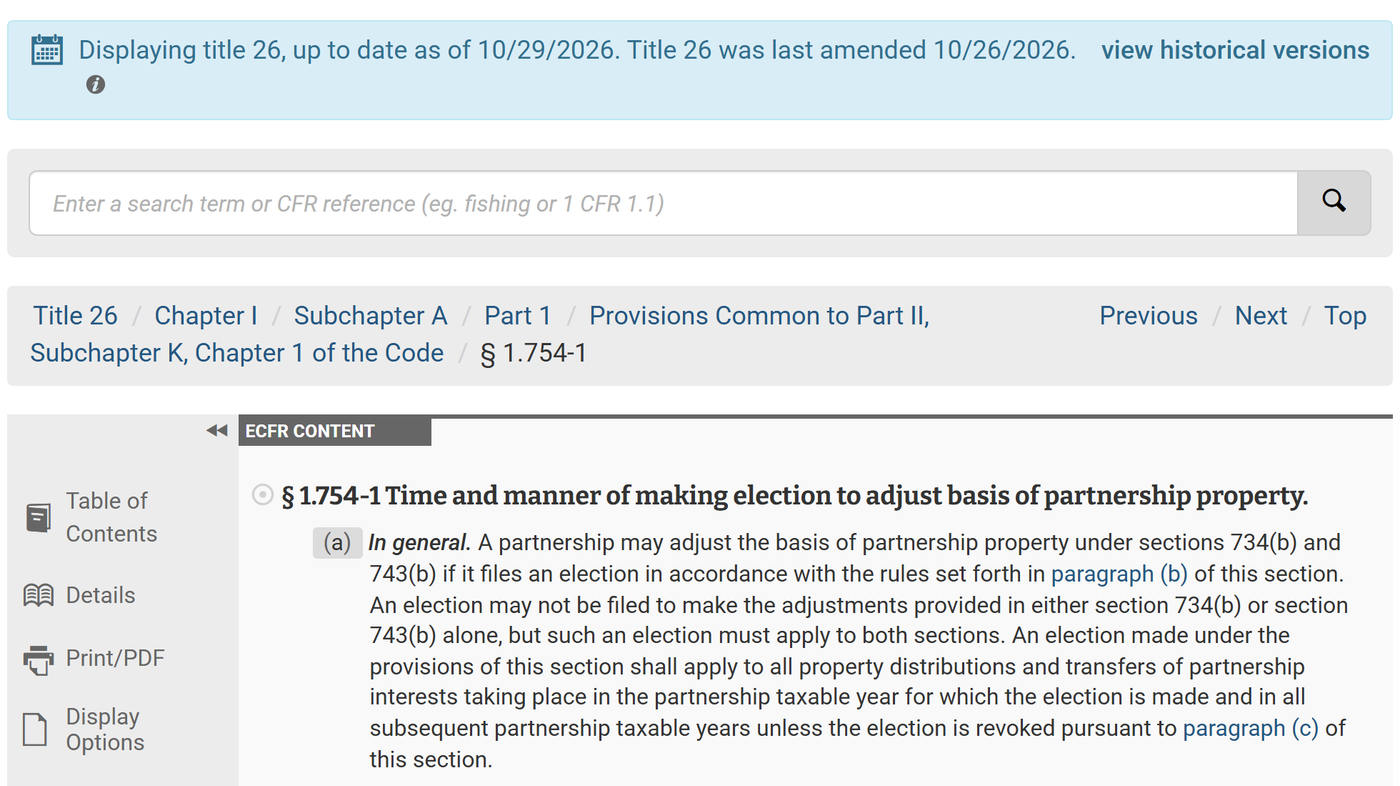
The Office of the Federal Register updates the eCFR daily. Its own guidance says the site is "generally current within two business days" and that amendments are "typically available about 2 business days after their effective date". Every content page carries a banner with the date the text is current to. On the day this was written, Title 26 read: "Displaying title 26, up to date as of 10/29/2026. Title 26 was last amended 10/26/2026." That date is the first thing to note in your working file.
- IRS Office of Chief Counsel.Drafts the regulation. T.D. 9963 names its author as an attorney in the Associate Chief Counsel office for passthroughs and special industries.
- Commissioner of Internal Revenue, or a deputy.Signs it for the IRS. T.D. 9963 was signed by the Deputy Commissioner for Services and Enforcement.
- Assistant Secretary of the Treasury for Tax Policy.Approves it for the Treasury Department. T.D. 9963 carries that approval, dated June 7, 2022.
- Office of the Federal Register.Publishes the Treasury Decision in the Federal Register, then works the new text into the eCFR. Its editors do not approve the rule; they record it.
- Administrative Committee of the Federal Register.The committee that oversees the Federal Register. It recognizes only the yearly printing on govinfo.gov as the official edition of the CFR.
04Which version governs the client's year
This is where tax differs from most of the CFR. A Treasury regulation usually applies by taxable year, not by the date it was published, and the two can be far apart.
Start at the end of the regulation. Most regulations changed since the 1990s end with a paragraph headed "Applicability date" or "Effective/applicability dates". It says which taxable years each paragraph covers, and it often lets a taxpayer choose to apply the new rule to earlier years that are still open.
Behind that paragraph sits §7805(b). A regulation, whether temporary, proposed or final, cannot reach a tax year that ended before the earliest of three dates: the day the regulation was filed with the Federal Register, the day a related proposed or temporary version was filed, or the day the IRS issued a notice describing what the regulation would say. There are exceptions. A regulation issued within 18 months of the law it carries out can reach back to the date that law took effect, and Treasury can make a rule reach back to stop abuse or where Congress allows it. The practical reading: if the regulation in front of you was filed after your client's year ended, check whether a notice or a proposed version was out before year end, and whether the 18-month rule applies, before assuming it governs.
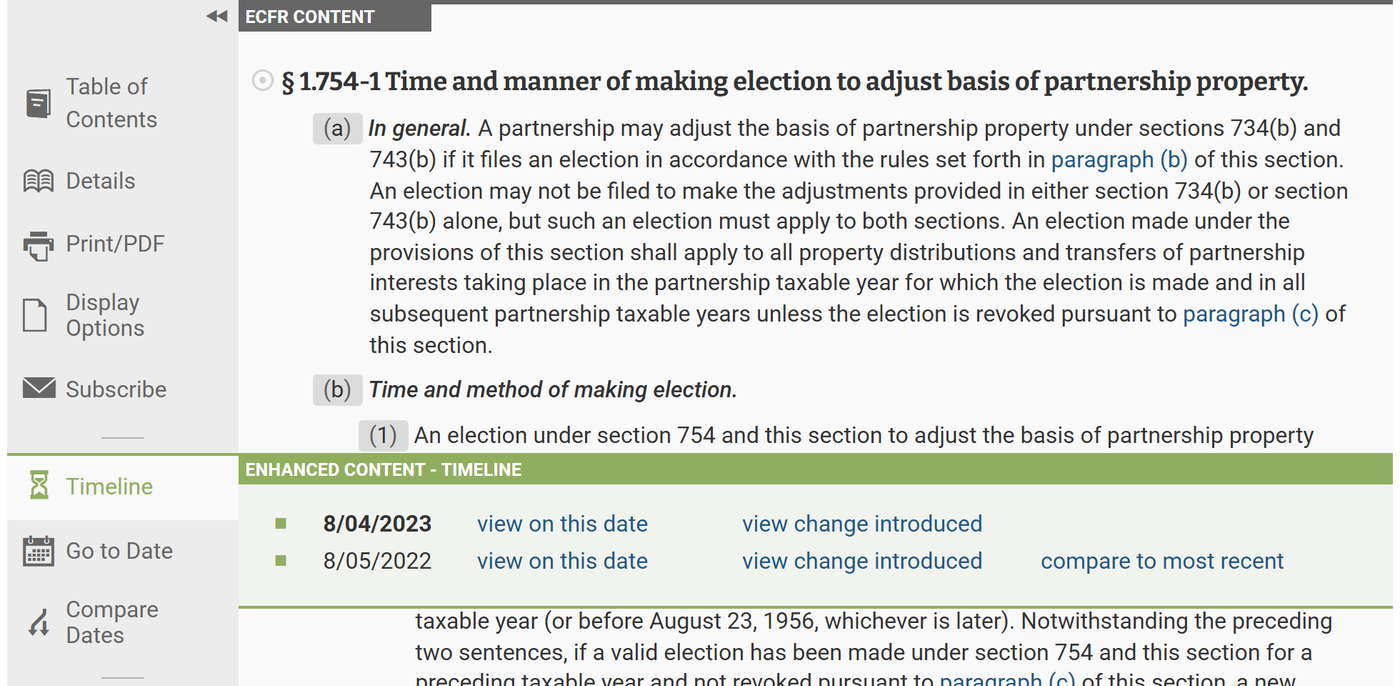
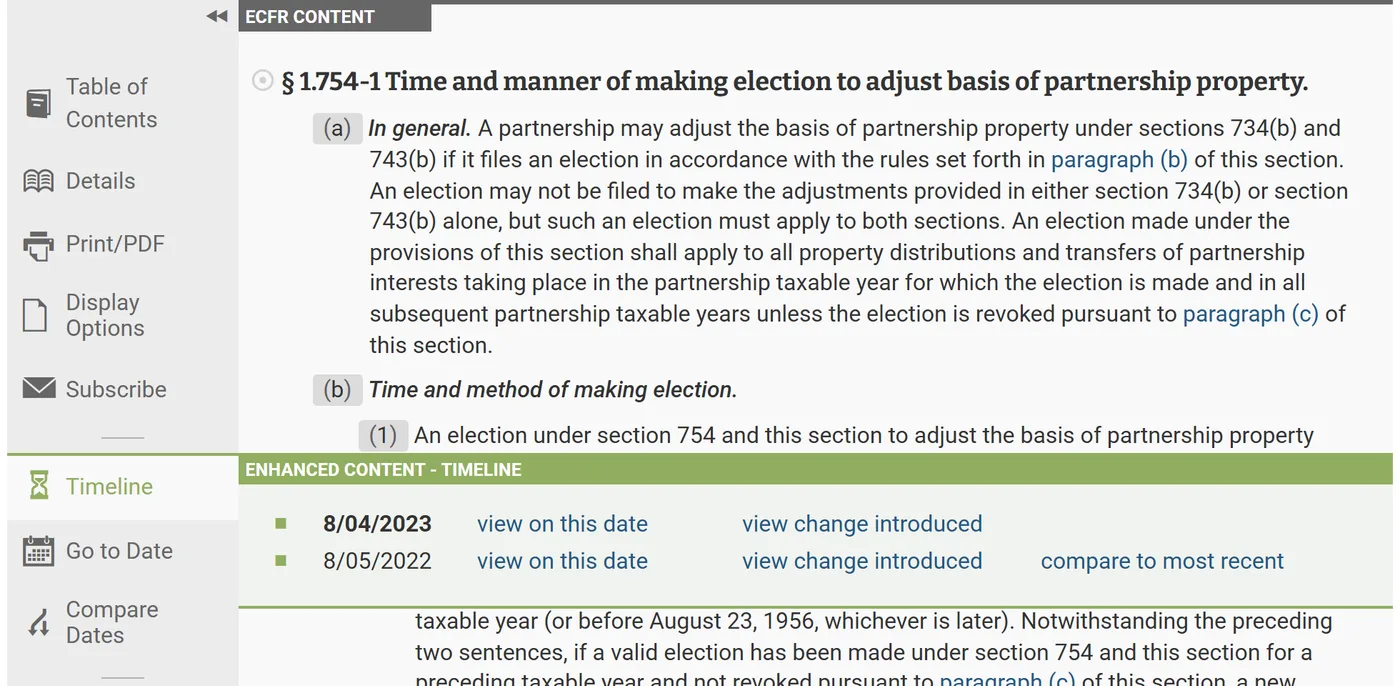
Then confirm the text. If the applicability paragraph says a 2024 return is governed by the version before a 2025 amendment, open the timeline, pick a date inside the client's taxable year, and read that version. Quote that one in your working file, with the date.
05Final, temporary and proposed, and how much weight each carries
The eCFR holds two of the three kinds of Treasury regulation.
Final regulations are the text you normally read. They were published as a proposal, took public comments, and were then made final, and they carry the full authority of a regulation.
Temporary regulations sit alongside final ones with a T at the end of the section number, §1.861-9T for example. They take effect without a comment period. Under §7805(e), a temporary regulation issued today must also be issued as a proposed regulation at the same time, and it expires three years after issuance. That three-year limit only applies to temporary regulations issued after November 20, 1988. Older ones never expire, and some are still the rule in force decades on: §1.861-9T, on allocating interest expense, was issued by T.D. 8228 on September 14, 1988 and remains in force. A T in the citation tells you the regulation skipped comment, not that it is about to expire. Check the source line for the date.
Proposed regulations are not in the eCFR at all. They are published in the Federal Register as proposed rules and stay there until made final or withdrawn, which can take years. They do not have the force of law. But the explanation published with them often says taxpayers may rely on the proposed rules until final regulations are issued, and when it does, a position on a return that follows them has a documented basis. Quote that sentence in your working file.
Since a 2024 Supreme Court decision called Loper Bright, courts no longer have to accept an agency's reading of an unclear law. A final regulation still applies until a court sets it aside, but where it stretches the Code, the Code wins, so read the Code section first and the regulation second.
06The preamble is in the Federal Register
The eCFR shows the text of the rule only. The explanation of why the rule reads as it does, the alternatives Treasury considered, the comments it accepted and rejected, and the examples it discussed are in the preamble, the explanation printed at the front of the Treasury Decision, and the preamble is published only in the Federal Register.
The route from one to the other is the source line in square brackets at the end of every regulation. For §1.754-1 it reads: [T.D. 6500, 25 FR 11814, Nov. 26, 1960, as amended by T.D. 7208, 37 FR 20686, Oct. 3, 1972; T.D. 8847, 64 FR 69916, Dec. 15, 1999; 65 FR 9220, Feb. 24, 2000; T.D. 9963, 87 FR 47932, Aug. 5, 2022].
Each entry is a Federal Register volume and page. On ecfr.gov the entries are links. On federalregister.gov or govinfo.gov the same citation opens the Treasury Decision with its preamble. When a regulation is unclear on your client's facts, the preamble is where the answer usually is.
07One regulation, top to bottom: §1.754-1
Open 26 CFR §1.754-1 on ecfr.gov and read it the way an IRS examiner would. If you want the rule itself rather than the reading method, our §754 election guide covers it.
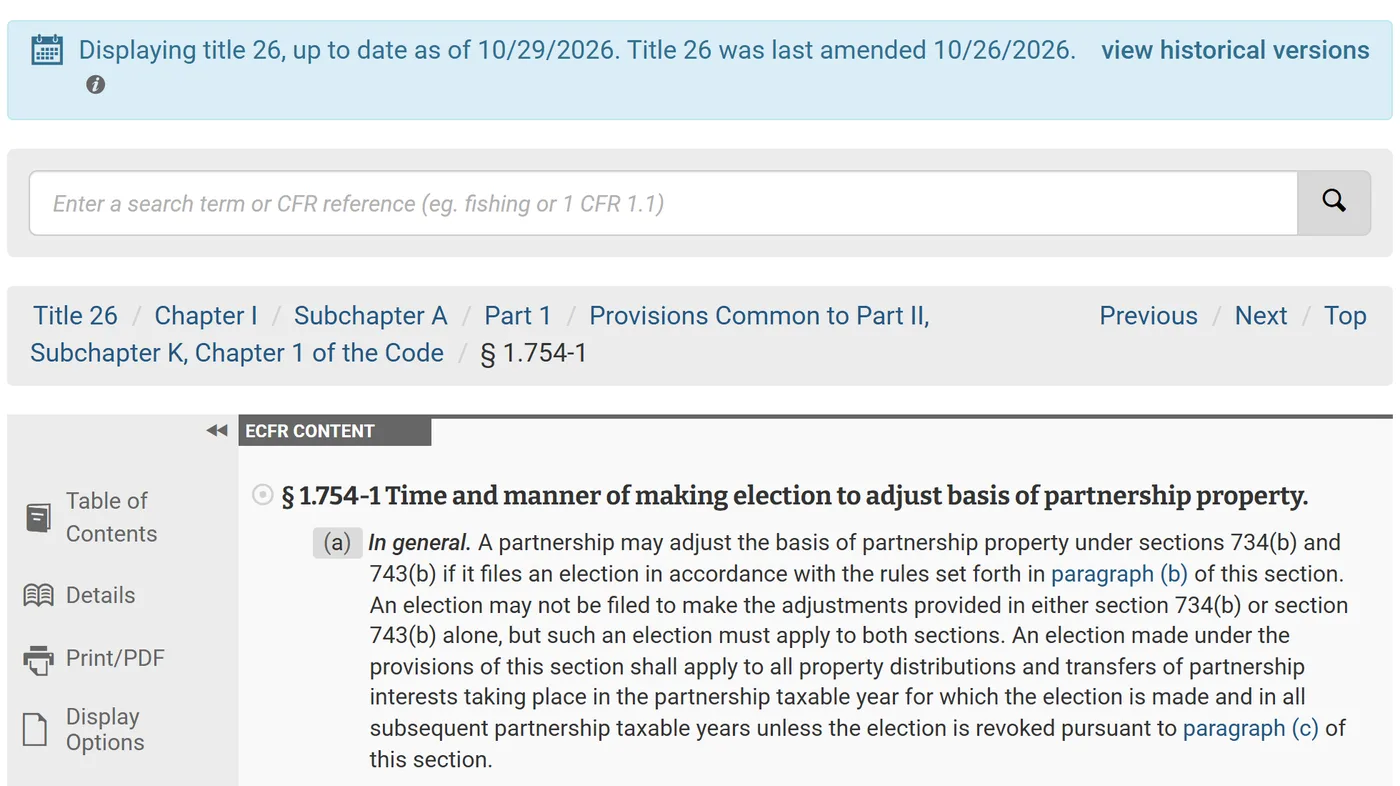
- The banner."Up to date as of 10/29/2026." Note it in your working file before anything else.
- The heading."§1.754-1 Time and manner of making election to adjust basis of partnership property." Part 1, Code §754, first regulation.
- Paragraph (a).The rule. A partnership adjusts basis under §§734(b) and 743(b) by filing an election, the election covers both sections, and it stays in force until revoked.
- Paragraph (b).Time and method. The election is a written statement with the return for the year of the transfer or distribution, filed by the due date including extensions. The example that follows is set in 1971, with a return due April 17, 1972. It is still accurate on the steps, and a reminder that regulation text is edited, not rewritten.
- Paragraph (c).Revocation needs the approval of "the district director", an office that disappeared in the IRS reorganization after the 1998 Restructuring Act. The regulation was never updated. Out-of-date office names like this are common in older regulations and do not stop the rule from applying; the IRS's current procedures tell you where the request actually goes.

- Paragraph (d).Applicability date, added in 2022: "The fourth sentence of paragraph (b)(1) of this section applies to taxable years ending on or after August 5, 2022", with permission to apply it earlier. That is the sentence T.D. 9963 rewrote when Treasury dropped the requirement that a partner sign the election statement. For a taxable year ending before that date, the earlier text is the one to read, unless the partnership chooses to apply the new sentence early.
- The source line.Five Federal Register entries from 1960 to 2022. Each is a Treasury Decision with a preamble. The 2022 entry explains the signature change.
08What goes wrong, and how to cite
Four failures account for most misread regulations.
- The Code moved and the regulation did not.Public Law 119-21, enacted July 4, 2025 and commonly called the One Big Beautiful Bill Act, rewrote dozens of Code sections, and the regulations have not caught up. §199A(b)(3)(B) now brings in the wage and property limits gradually over the $75,000 of taxable income above the threshold, or $150,000 on a joint return, for taxable years beginning after December 31, 2025. §1.199A-1(b)(4) still defines the phase-in range as $50,000 and $100,000. The regulation is right for a 2025 return and wrong for a 2026 one. Read the Code section's own effective-date notes before the regulation.
- There is no regulation yet.§174A, the deduction for domestic research costs that the same law created for amounts paid in taxable years beginning after 2024, has no regulations under it. The guidance so far is in notices and revenue procedures in the Internal Revenue Bulletin, and that is where you research it until Treasury issues regulations.
- A proposed regulation read as settled.It is not in the eCFR, so if you are reading one you are in the Federal Register. Check whether it was made final, and check whether its explanation says taxpayers may rely on it.
- A temporary regulation assumed to have lapsed, or assumed to be current.Check the source line date against November 20, 1988 and the three-year rule.
That is also how we built the assistant's citations. Partnertax AI holds Title 26 of the CFR pulled from the eCFR, with the eCFR's own current-as-of date, and every regulation it cites carries that date and a link to the official page, so a reviewer can open the source and check it in one click. The same approach covers the Code, the Internal Revenue Bulletin and the other primary sources described in how to verify an AI tax answer against primary sources.