On this page
I use ChatGPT. Most practitioners I talk to do too, and the first thing many of them tried was a tax question. So when I say I built a tax research tool, the next question arrives fast: why would anyone pay for that when ChatGPT is right there? It is a fair question and I have had to answer it enough times to have a real answer. To keep myself honest, every statement about ChatGPT in this article comes from OpenAI's own documentation, and the links are at the bottom.
01They were built to do different things
ChatGPT is built to help with anything. OpenAI says it trains its models on public sources, licensed third-party data, and material written by human reviewers. "Public sources" means the open web. The Internal Revenue Code is on the open web. So is every forum thread where someone confidently explains a deduction they have misunderstood, and the model learned from both. Since October 2024 it can also search the web and show links to what it found. Tax is one topic among thousands it covers.
Partnertax AI does one thing. You ask a federal or state tax question, it researches the question against a library we publish (the Code, Treasury regulations, IRS rulings and guidance, court opinions, and the statutes and regulations of all 50 states), and it writes back an answer with the authority cited. You can look at the whole library at library.partnertax.ai before you ask anything. We also built the reasoning the way I was trained to do research: what is the issue, what does the authority say, how does it apply to these facts, what is the conclusion, and cite as you go. A general assistant is built to give you a fluent answer. This one is built to give you a defensible one. Different jobs.
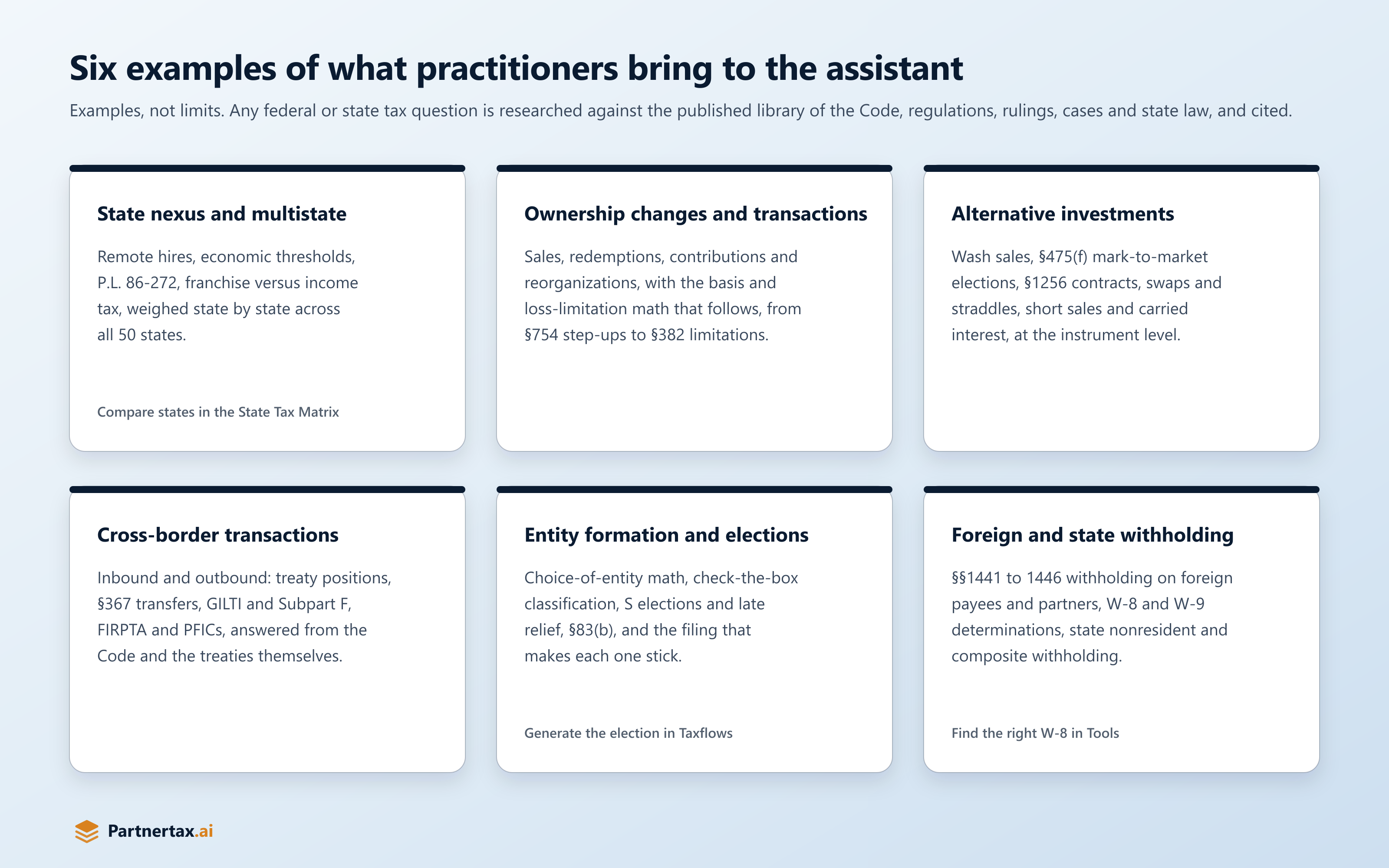
Say a client operates in four states. The questions come in a bundle: did the remote hire create nexus, how does each state apportion the income, does the state tax the entity or the owners, what gets withheld on the nonresident partners, which elections should the entity make and where. The figure shows six examples of the areas those questions fall into: state nexus and multistate questions, ownership changes and transactions, alternative investments, cross-border transactions, entity formation and elections, and foreign and state withholding. Examples, not boundaries. Any federal or state tax question gets the same treatment: look it up in the library, cite the authority. For the state-by-state view of a question like that, the State Tax Matrix at partnertax.ai/state-tax-matrix lays the states out side by side.
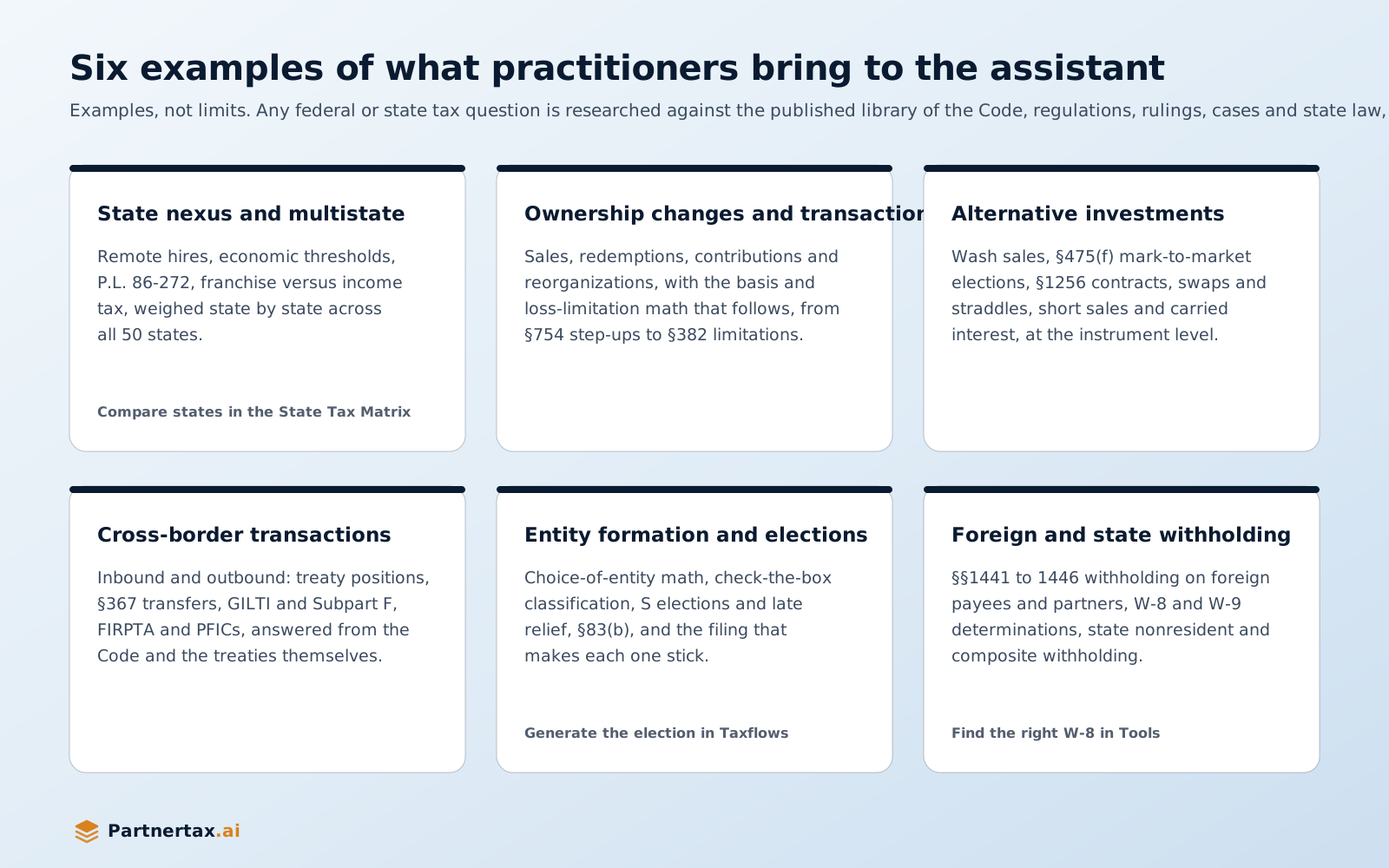
- State nexus and multistate.Whether a remote hire or a sales threshold pulls a client into a state, and what each of the 50 states does once it has.
- Ownership changes and transactions.The basis and loss-limitation math that follows a sale, redemption, contribution or reorganization, from a §754 step-up to a §382 limit.
- Alternative investments.The instrument-level questions funds and traders live in: wash sales, §475(f) elections, §1256 contracts, swaps, straddles, carried interest.
- Cross-border transactions.Inbound and outbound positions answered from the Code and the treaties themselves: §367 transfers, GILTI and Subpart F, FIRPTA, PFICs.
- Entity formation and elections.Choice of entity, check-the-box, S elections and late-election relief, §83(b), and the filing that makes each one stick.
- Foreign and state withholding.Who withholds, how much, and on which form, under §§1441 to 1446 and the state nonresident and composite rules.
02Where the answer comes from
Ask ChatGPT a tax question with search off and the answer comes from what the model remembers from training. For well-known rules it is often right. But there is no document behind the sentence. There is nothing to click. Turn search on and OpenAI says you get links to relevant web sources, which might be an IRS page, a law firm's blog, or a discussion thread, depending on what the search surfaced that day. Now you are judging the source as well as the answer.
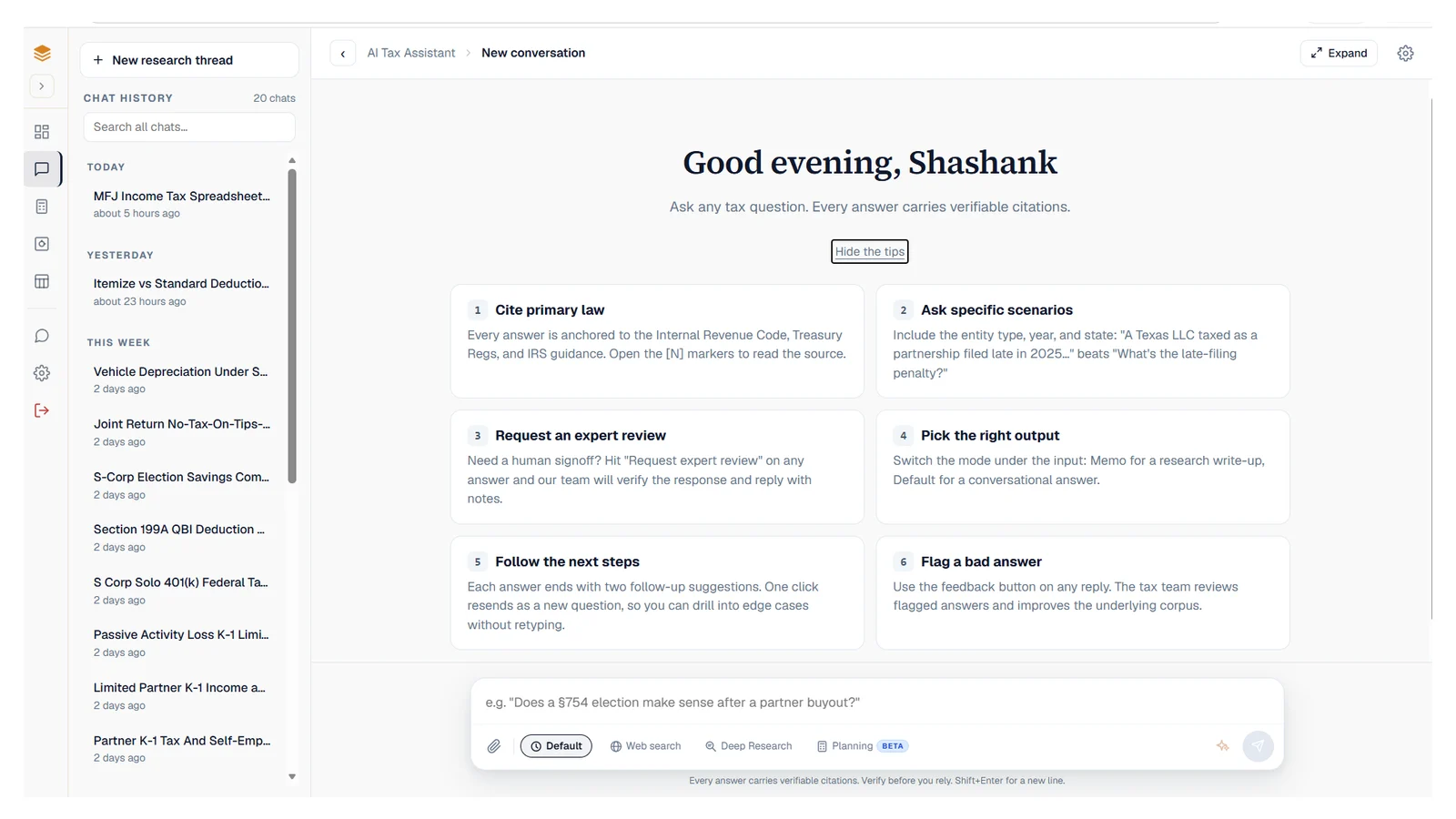
Partnertax AI starts with the authority. The answer is written from the retrieved sections of the Code, the regulation or the ruling, and every claim has a numbered marker that opens the source text. If you want it as a memo, switch the mode and it comes back as Issue, Analysis, Conclusion and Authorities Cited, which is what a reviewer expects to find in the workpapers. The modes, document attachments and expert review are described on the AI Tax Assistant page at partnertax.ai/products/ai-tax-assistant. Ask a state question and the citation is to that state's own statute or regulation, not to a federal summary with the state's name swapped in.
03When the model does not know
OpenAI is more candid about this than people expect. In a research note published on September 5, 2025, it defines hallucinations as "plausible but false statements generated by language models" and says they "remain a fundamental challenge for all large language models". Its diagnosis is that the way models are trained and scored rewards a confident guess over "I don't know". One of its listed findings is blunt: "accuracy will never reach 100% because, regardless of model size, search and reasoning capabilities, some real-world questions are inherently unanswerable."
I want to be careful here, because the same technology sits under our product. I am not going to tell you Partnertax AI cannot be wrong. What I can tell you is that its answer can only draw on a library we publish, and every sentence points at a source you can open. That changes the question you have to answer from "is this right?" to "does the cited section say what this sentence says?", and that second question is one a practitioner can settle in a minute. Web search mode is there for a different reason: when you want to see what the industry is saying about a question, a firm's commentary or a practitioner forum, next to what the authority says, with the web material labeled so you never mistake one for the other. And when an answer is going to carry weight, you can ask for a human review, and someone on our tax team reads it and replies with notes.
04Where the client's data goes
This is the part most firms have not thought through, and OpenAI's documentation is clear on it. On the individual ChatGPT plans, your conversations may be used to improve OpenAI's models unless you turn off "Improve the model for everyone" under Data controls. On ChatGPT Business, Enterprise, Edu and the API, OpenAI says business data is not used for training by default, you keep the rights to what you put in and own what comes out, and the workspace admin controls how long it is kept. So a partner pasting a client's return into a personal ChatGPT login and an associate doing the same in the firm's Enterprise workspace are in different positions, and the difference is a setting.
Our privacy policy says what we do. The data you give us is not used to train third-party AI models, and your identity and documents are not shared with AI providers for their own training. Documents you attach, and books you connect through QuickBooks or Xero, are used to answer your questions. No third party gets to use your data for its own purposes.
05ChatGPT vs. Partnertax AI: side-by-side comparison
| ChatGPT | Partnertax AI | |
|---|---|---|
| Built for | Any task, any subject | Federal and state tax questions |
| Answers from | Model training on public and licensed data; web search results when search is on | A published library of the Code, regulations, IRS guidance, rulings, court opinions and state law |
| Citations | Links to web sources when search is used | A citation on every claim, opening the authority text |
| The Partnertax library inside the tool | Yes, through the PartnerTax MCP server | Built in |
| Tax figures | Not a stated feature | Planning mode calculates federal tax and savings from the client's facts |
| Training on your data | Individual plans: on unless switched off. Business, Enterprise, Edu, API: off by default | Not used to train third-party AI models |
| Human review | Not a stated feature | Expert review on request from the Partnertax tax team |
The ChatGPT column sticks to what OpenAI publishes. "Not a stated feature" means I could not find it in the documentation I cite, not that it does not exist.
06Where ChatGPT still earns its place
When you are the source of the facts and the law is not in question, a general assistant is the better tool, and I use one for exactly this kind of work. The email that explains a result to a client. Turning a dense paragraph into something a cover letter can carry. Summarizing a forty-page engagement letter. Explaining a concept to a new hire. Drafting the firm's AI policy. You already know the answer and you want help with the words. The data rule above still applies.
Research is a different job. "Does one remote employee in another state create income tax nexus for my client?" has an answer in that state's statute and the cases that interpret it. The answer has to be right, and someone has to sign it. That is what we built Partnertax AI for.
And it is not either-or. If you would rather stay in ChatGPT or Claude, you can bring our library into it. The PartnerTax MCP server connects the same federal and state tax law to Claude, ChatGPT and any MCP-compatible assistant, so your assistant searches the actual statutes, regulations and IRS guidance and cites the official source. Setup is at partnertax.ai/mcp.
FAQFrequently asked questions
Can I use ChatGPT for tax research?
You can ask it tax questions and it will answer. The question is what you can do with the answer. OpenAI describes hallucinations, plausible but false statements, as a fundamental challenge for all large language models. Before anything goes in a client file, each statement has to be traced to the Code, a regulation or a ruling.
Does ChatGPT use my conversations to train its models?
On the individual plans, OpenAI's help documentation says conversations may be used to improve its models unless you turn off the "Improve the model for everyone" setting. For ChatGPT Business, Enterprise, Edu and the API, OpenAI says business data is not used for training by default. Which plan the firm is on matters.
Where does Partnertax AI get its answers?
From a library we publish: the Internal Revenue Code, Treasury regulations, IRS guidance and rulings, court opinions, and state statutes and regulations. Every answer lists the sources it drew on, and each citation opens the authority itself.
Does Partnertax use my data to train AI models?
No. Our privacy policy states that data you provide is not used to train third-party AI models, and that your identity and documents are not shared with AI providers for their own training.
Can I use the Partnertax library inside ChatGPT or Claude?
Yes. The PartnerTax MCP server connects the library of federal and state tax law to Claude, ChatGPT and any MCP-compatible assistant, which then searches the actual statutes, regulations and IRS guidance and cites the official source. Setup is at partnertax.ai/mcp.
Is there still a place for ChatGPT in a tax practice?
Yes, for work where you are the source of the facts: drafting a client email, rewriting a paragraph, explaining a concept to a junior. The IRS Office of Professional Responsibility's 2026 guidance accepts AI in tax practice and ties it to the existing Circular 230 duties, including reviewing AI-created content and keeping taxpayer data in secured systems.