Over the past few weeks a number of users brought us FATCA questions: whether chapter 4 withholding applies to gross proceeds in 2026, which status box a Reporting Model 1 FFI certifies on Form W-8BEN-E, whether a UK pension scheme is a reporting institution under the UK agreement, and whether a client with one foreign bank account owes an FBAR on top of Form 8938. The library already held the primary FATCA authority: sections 1471 through 1474 and 6038D of the Code, the full set of chapter 4 regulations, the FFI and QI agreement revenue procedures and the reporting relief notices. The questions showed us that FATCA practice reaches well beyond that core, into Treasury's intergovernmental agreements, a proposed regulation taxpayers rely on, the W-8 instructions and FinCEN's Bank Secrecy Act rules. So we built those layers in. This article walks through what they are, what we added, and what difference it makes, in the form of the questions users asked and the ones we asked ourselves along the way.
What is FATCA, in one paragraph?
The Foreign Account Tax Compliance Act, enacted in 2010 as chapter 4 of the Internal Revenue Code (sections 1471 through 1474), requires foreign financial institutions to identify and report their U.S. account holders to the IRS, and backs that requirement with a 30 percent withholding tax on certain U.S. source payments to institutions that do not comply. A companion provision, section 6038D, requires U.S. individuals to report specified foreign financial assets on Form 8938 with their return. The regime is implemented through Treasury regulations, through more than a hundred intergovernmental agreements with other countries, through IRS registration and reporting systems, and through a family of withholding certificates (the W-8 forms) that every withholding agent relies on. That spread of sources is the whole story of this release.
What is an FFI?
A foreign financial institution: any non-U.S. entity that accepts deposits in the ordinary course of a banking or similar business, holds financial assets for the account of others, or is in the business of investing, reinvesting or trading in securities, partnership interests or commodities, plus certain insurance companies that issue cash value or annuity contracts. In practice that means foreign banks, brokers and custodians, and also most foreign investment funds, hedge funds, private equity vehicles and trusts that are professionally managed, which is why a Cayman fund with no U.S. operations is an FFI. The definition sits in section 1471(d)(4) and (5) and in regulation 1.1471-5(d) and (e), and each intergovernmental agreement restates it with country-specific carve-outs. An FFI that does not participate in FATCA (a nonparticipating FFI) is the one subject to 30 percent withholding on payments it receives from U.S. sources. The counterpart term, NFFE, is a non-financial foreign entity, an operating company or holding company that is not an FFI and reports its substantial U.S. owners instead.
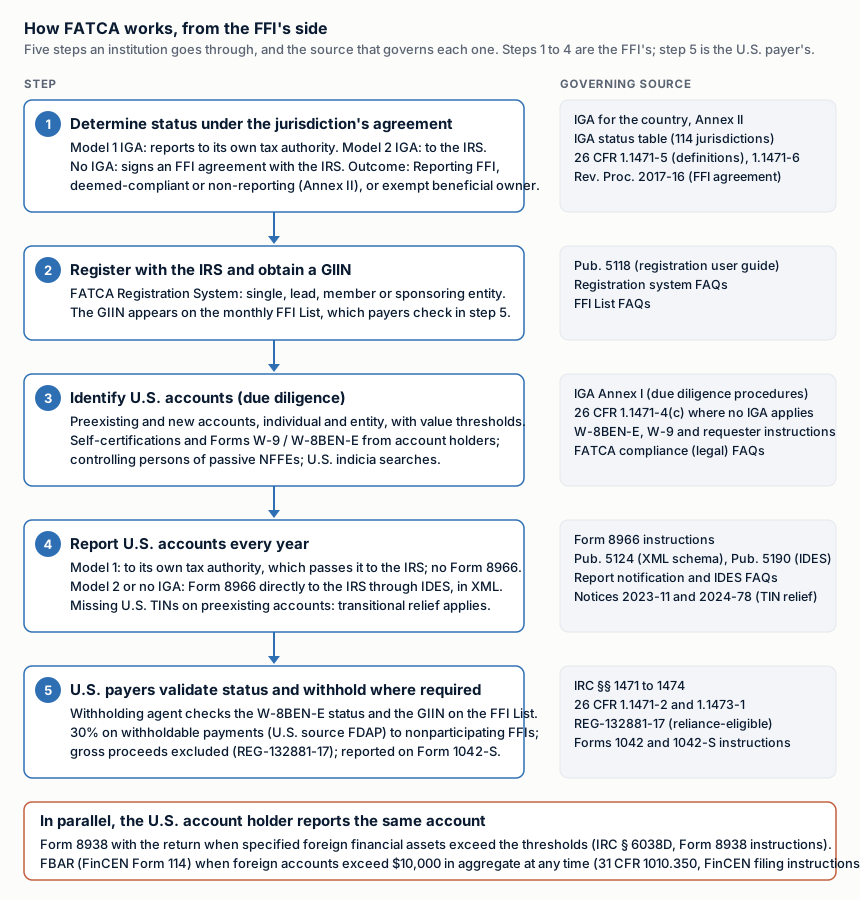
How does FATCA work, from the FFI's side?
Five steps, each governed by a different source. The institution first works out its status under its own country's agreement, registers with the IRS to obtain a GIIN, identifies its U.S. accounts under the agreement's due diligence procedures, and reports them each year, to its own tax authority under a Model 1 agreement or to the IRS directly under Model 2. The fifth step belongs to the U.S. payer: a withholding agent validates the institution's status and withholds 30 percent on withholdable payments only where the institution is nonparticipating. The column on the right shows where each step's rules live, and it is the reason this release reaches beyond the Code and the regulations.
Why do the intergovernmental agreements matter more than the regulations for an FFI question?
Because most foreign financial institutions never operate under the regulations directly. Treasury has concluded agreements with 114 jurisdictions. Under a Model 1 agreement (96 jurisdictions, including the United Kingdom, Canada, Germany, India and the Cayman Islands) the institution reports to its own tax authority, which exchanges the information with the IRS, and its due diligence follows the agreement's Annex I. Under a Model 2 agreement (Switzerland, Japan, Austria and a handful of others) the institution reports to the IRS directly, but under terms the agreement modifies. Each agreement's Annex II lists the pension funds, government entities and small or local institutions that are treated as exempt beneficial owners or deemed-compliant in that country. A question such as "is a UK registered pension scheme a reporting financial institution" is answered by the UK agreement's Annex II, and by nothing in the regulations.
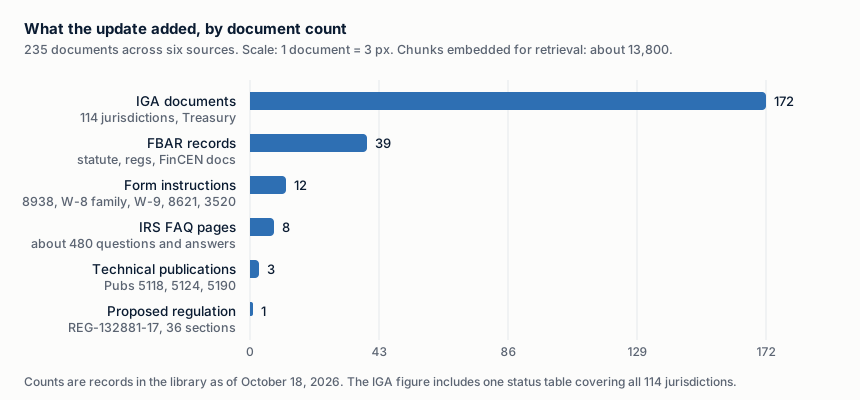
The library now holds all 171 documents Treasury publishes: 109 agreements (one superseded Singapore agreement kept for the years it governed), 40 memoranda of understanding, 17 related agreements and arrangements that amend terms by exchange of notes, and five corrections. Each agreement is split by article and by the sections of its two annexes, so a citation can point at Annex II of a specific country. A status table record, one section per jurisdiction, carries Treasury's own columns: model, status, the date the agreement entered into force, and the date the jurisdiction was treated as having an agreement in effect. Seven jurisdictions, China among them, have an agreement in substance but no signed text; they appear in the status table only. Five documents exist only as image scans on Treasury's site and were converted with optical character recognition; their pages say so, and the signed PDF remains the authoritative text.
One design decision is worth stating. Citations from an agreement page redirect to the Treasury PDF rather than to our rendering of it. An agreement is a treaty-like instrument, and a practitioner relying on it should land on the signed document.
The FBAR is not part of FATCA. Why is it in a FATCA release?
Because practitioners ask about them together, and the comparison is the single most common cross-border question individual practitioners field. The Report of Foreign Bank and Financial Accounts, FinCEN Form 114, is required by 31 U.S.C. section 5314 and 31 CFR section 1010.350, administered by the Financial Crimes Enforcement Network, and filed through the BSA e-filing system rather than with a tax return. Form 8938 is a tax provision with different thresholds, a different definition of what is reported, and a different penalty regime. A client with a single foreign bank account may owe both filings, one of them, or neither. A library organized around Title 26 holds the Form 8938 side naturally; the FBAR side has to be brought in on purpose, and now it is.
We built the FBAR as one topical corpus rather than scattering it by source type: the three sections of Title 31 that create the requirement and the civil and criminal penalties, the five sections of 31 CFR part 1010 that implement it (including the inflation-adjusted penalty table, which currently sets $16,536 for a non-willful violation and $165,353 for a willful one), FinCEN's line-item filing instructions and electronic filing specifications, Form 114a, the IRS FBAR Reference Guide, and every FinCEN FBAR notice, including the chain of signature-authority extensions that currently runs through FIN-2025-NTC3 and the disaster relief notices back to 2017. The statute text comes from the Office of the Law Revision Counsel's current release point, the same source as the Internal Revenue Code in the library, rather than from an annual edition that lags enacted law.
What about the forms?
The library already held the instructions for Forms 8966, 1042 and 1042-S, which is what an FFI or a withholding agent files. The questions users brought were about what determines the filing: how a payee's status is documented and what an individual reports. We added the instructions for Form 8938, for each of the W-8 certificates (W-8BEN, W-8BEN-E, W-8IMY, W-8ECI and W-8EXP), for the requester of the W-8 series, and for the requester of Form W-9, which together govern how a withholding agent documents a payee's chapter 4 status. The W-8BEN-E instructions alone run to 55 sections, one per part of the form, so a question about which status box a Reporting Model 1 FFI certifies, and whether it needs a GIIN, now resolves to a specific part. We also added the instructions for Forms 8621, 3520, 3520-A and 8833, which are not FATCA forms but arrive in the same engagements.
And the IRS FAQs and technical publications?
The IRS publishes most of its operational FATCA guidance as web pages rather than in the Internal Revenue Bulletin, so the registration, transmission and notification questions that FFIs and their advisers ask are answered there and nowhere else. We added eight FAQ pages, roughly 480 questions and answers in all: the compliance and legal FAQs, the registration system FAQs, the IDES technical FAQs, the report notification FAQs (what each error code means and what to do), the FFI list FAQs, the qualified intermediary FAQs, the Form 8938 basic questions, and the IRS comparison table of Form 8938 and FBAR requirements. Each question is its own citable section, and each page opens with a status note that FAQs are not binding guidance and cannot be cited as authority, which is the IRS's own position. Three technical publications joined them: Publication 5118, the registration user guide; Publication 5124, the XML schema guide for Form 8966; and Publication 5190, the IDES transmission guide.
How does the new material stay current?
- Statute. The Code is rebuilt from the Office of the Law Revision Counsel's release point whenever a new one is published; the weekly check compares release points, so a new public law is the signal.
- Proposed regulation. The Federal Register is queried weekly by Regulation Identifier Number and docket; any action not already accounted for in the status note is flagged for review.
- Agreements. Treasury's table of agreements by jurisdiction is re-parsed on each refresh, so a newly signed agreement, a new memorandum of understanding or a changed status appears as a new or changed record.
- FBAR. FinCEN's FBAR page is the source of truth for notices; the fetcher validates each document against its own text, which is how we caught two notices whose file names did not match their contents.
- Forms and FAQs. These ride the existing IRS refresh, which checks each page's version stamp and re-extracts when it changes.
What is deliberately not covered?
Three categories, each a choice rather than an oversight. The pre-2015 FATCA notices (Notice 2010-60 through Notice 2014-33 and Revenue Procedures 2014-38 and 2014-39) were superseded by the regulations and the later agreement revenue procedures; they matter for history and rarely for a current filing. The preambles to the final regulations (T.D. 9610, T.D. 9809 and T.D. 9890) are excluded because the regulation text they produced is already in the library and the preambles are commentary. And the assistant's answers from IRS FAQs carry the IRS's own caveat that an FAQ cannot be cited as legal authority, even when it is the only place a particular operational question is answered.
FATCA coverage in the Partnertax library, as of October 18, 2026
| Layer | What the library holds | Source |
|---|---|---|
| Statute | IRC §§ 1471 to 1474, § 6038D, and related §§ 1441 to 1446, 1461 to 1464, 6038, 6048, 6662, 6679; current through Pub. L. 119-121 | Office of the Law Revision Counsel |
| Final regulations | 26 CFR §§ 1.1471-0 to 1.1474-7, 301.1474-1, 1.6038D-0 to 1.6038D-8, the 1.1441 series, 1.1461-1 to -3, 1.6049-5 | eCFR (Title 26) |
| Proposed regulations | REG-132881-17 (83 FR 64757) with a verified status note; 36 sections | Federal Register |
| Intergovernmental agreements | 109 Model 1 and Model 2 agreements, 40 MOUs, 17 related agreements, 5 corrections; status table for all 114 jurisdictions | U.S. Treasury |
| IRS published guidance | Rev. Proc. 2017-16 (FFI agreement), Rev. Proc. 2022-43 (QI agreement), Rev. Proc. 2017-21 (WP/WT), Notices 2015-66, 2016-8, 2017-46, 2023-11, 2024-26, 2024-78 and the rest of the Bulletin from 2015 | Internal Revenue Bulletin |
| IRS FAQs | Compliance (legal), registration system, IDES technical, report notifications, FFI list, qualified intermediary, Form 8938 Q&A, Form 8938 vs. FBAR comparison | IRS.gov |
| Technical publications | Pub. 5118 (registration), Pub. 5124 (XML schema), Pub. 5190 (IDES), Pub. 515 (withholding) | IRS |
| Forms | Instructions for 8938, 8966, 1042, 1042-S, W-8BEN, W-8BEN-E, W-8IMY, W-8ECI, W-8EXP, requester of W-8, requester of W-9, 8621, 3520, 3520-A, 8833 | IRS |
| FBAR | 31 USC §§ 5314, 5321, 5322; 31 CFR §§ 1010.306, .350, .420, .810, .821; FinCEN filing instructions, e-filing specifications, Form 114a, IRS Pub. 5569, every FinCEN FBAR notice | OLRC, GovInfo, FinCEN, IRS |
Every record above is a page in the Partnertax library at library.partnertax.ai, with the source document linked, and every answer the assistant gives from it carries the citation. If you work a FATCA engagement and there is a document you want the assistant to read from, tell us. That is how this release started.
Shashank Sharma is the founder of Partnertax.ai, an AI tax assistant for tax professionals, built on cited IRS and Treasury sources.