For decades, making an 83(b) election meant drafting your own statement letter to the IRS — there was no official form, just a list of required contents buried in the regulations. Form 15620, introduced in late 2024, changed that: nine numbered boxes, a signature line, and since 2025 the option to file it online through the IRS portal instead of mailing it. Using the form is optional — a self-drafted statement letter is still valid — but for most founders the form is now the fastest path.
What the form didn't change is the vocabulary. The boxes still speak regulation: "property subject to election," "fair market value at time of transfer." Here is what each box actually asks, using the classic founder case — you bought 1,000,000 shares of your own startup at $0.0001 per share, vesting over four years.
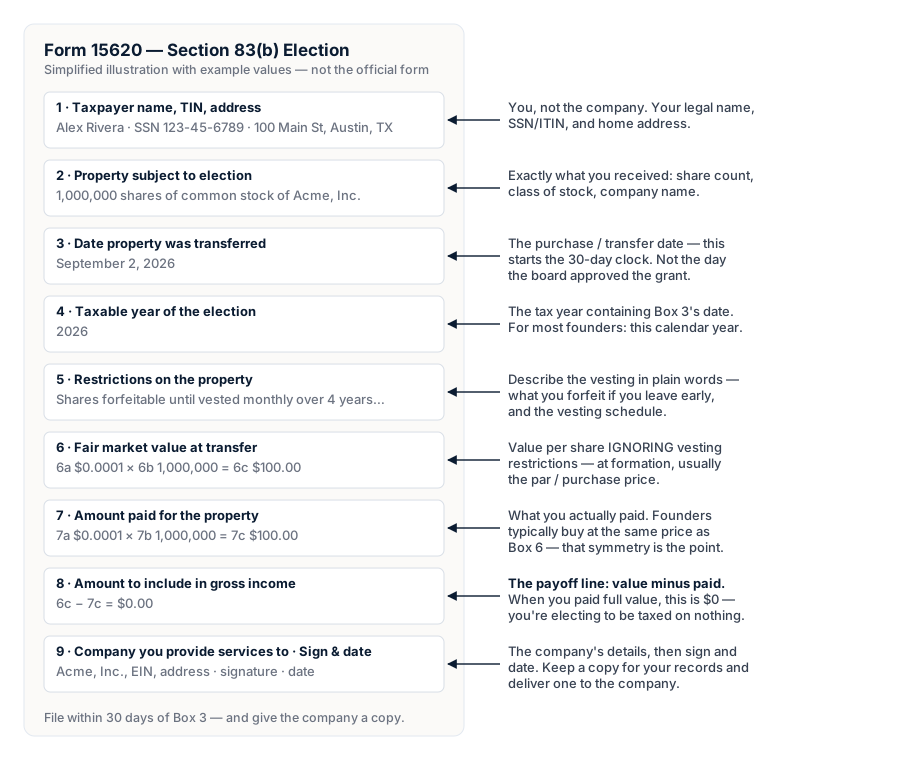
Boxes 1–4: who, what, and when
- Box 1 — Taxpayer name, TIN, address. You, not the company. Your legal name, your Social Security number (or ITIN), your home address. The election is personal: it's the founder telling the IRS how to tax the founder.
- Box 2 — Property subject to election. What you received, described precisely: "1,000,000 shares of common stock of Acme, Inc." Share count, class of stock, company name.
- Box 3 — Date the property was transferred. The date the stock was actually transferred or purchased — generally the date on your stock purchase agreement, not the earlier day the board approved the grant. This date starts the 30-day filing clock, which has no extensions.
- Box 4 — Taxable year. The tax year that contains Box 3's date. For nearly every founder that's simply the current calendar year.
Box 5: describe the vesting
"Restrictions" means the strings attached to your stock — in founder terms, the vesting. Plain English works: "The shares are subject to repurchase by the company at cost if the taxpayer's service ends, lapsing as to 1/48th of the shares monthly over four years." You're telling the IRS why this stock is "substantially nonvested" — which is the whole reason an election is available.
Boxes 6–8: the arithmetic that's usually zero
- Box 6 — Fair market value at transfer. Value per share (6a) times share count (6b) equals total (6c) — and the value is determined ignoring the vesting restrictions. At incorporation, before the company has meaningful assets or revenue, the fair market value is typically the price in your purchase agreement: $0.0001 × 1,000,000 = $100 in our example. At a later stage the number is real and this line deserves a valuation conversation.
- Box 7 — Amount paid. What you actually paid, in the same per-item × quantity format. Founders typically purchase at fair market value, so this mirrors Box 6: $100.
- Box 8 — Amount to include in gross income. Box 6c minus Box 7c. When you paid full value, this is $0 — the entire election amounts to telling the IRS "tax me now on nothing, instead of later on a lot." That one subtraction is why founders file this form.
Box 9 and the last two steps
Box 9 asks for the company you provide services to — name, EIN, address — then you sign and date. Two steps remain after the form itself: file it within 30 days of Box 3's date (online through the IRS portal with an ID.me sign-in, or by certified mail with return receipt if you want paper proof — use one method, not both), and give a copy to the company for its records, which the regulations require. If your stock was issued through a cap table platform like Carta or Pulley, check what filing support it provides.
If you'd rather see it as a letter
The form is optional; the traditional election statement remains valid, and reading one is still the best way to understand what you're electing. Our free 83(b) election letter template generates the complete statement with every required element — no signup. For the rest of the first-year picture — the Delaware franchise tax notice, the filings due at zero revenue — see The Founder's First-Year Tax Checklist. And when your situation stops matching the classic case (you paid less than fair market value, the stock isn't plain common, a co-founder is abroad), that's a question for the AI Tax Assistant — answered with citations to the Code and regulations, free tier, no card.
IRS Form 15620, Section 83(b) Election. Available at: irs.gov/pub/irs-pdf/f15620.pdf
Shashank Sharma is the founder of Partnertax.ai, an AI tax assistant for tax professionals, built on cited IRS and Treasury sources.